Patricia Sargent

Author of Ancient Power Women Series

Follow Patricia on LinkedIn
  • home
  • about the series
  • books
  • bio
  • blog
  • gallery
  • mailing list
  • contact

Recent Posts

  • They Called Her Emperor
  • Attitude is Everything
  • The Blood Red Fabric of Tribal Life
  • Bravery a Norm for Women
  • The Magic of Words

Archives

They Called Her Emperor

March 28, 2024 by Patricia Sargent Leave a Comment

In ancient times, wealthy Chinese families submitted their young daughter to the court to serve as a concubine in the hope that she might marry the emperor and elevate  her family to the privileges of officialdom, political influence, and wealth.


Passing the requirements of beauty, intelligence, and pleasant poise, fourteen-year-old Wu  Zeitian became a lower-rank concubine of the Tang Emperor Taizong. Her duties as chambermaid in the ailing emperor’s bedroom were to clean his chamber, change his bedsheets, empty his bedpan, and attend  his needs. Wu profited from Taizong’s stories of plotted family coups and assassination attempts. He shared the court’s “back road” intrigues, war strategies, advised her whom to distrust, and cautioned her to prepare a defense against the multitude of those clamoring for  privileges. A good listener and a cheerful companion, the bright young woman exceled in the language of the people and embraced the lessons that would serve her future.


Taizong’s heir, who occasionally visited his father, fell in love and married the exceptional Wu. In time, when the young emperor unfortunately experienced a stroke, Empress Wu wisely helped him to write and respond to edicts. With his passing, her influence and discernable leadership rewarded her as the Empress Regnant. For years, she governed the Chinese Empire, judiciously rebuilding the reputation of the Tang Dynasty. So respected was she that many citizens referred to her as Emperor Wu.


Grātiās tibi !
Dr. P. D. Sargent

Ancient Scribe sharing new ideas twice a month 

 

Filed Under: Blog

Attitude is Everything

March 8, 2024 by Patricia Sargent Leave a Comment

Acknowledging International Women’s Day, we ponder what it takes to succeed. Presidents of international organizations and major universities, Leaders of Labor Unions, and CEOs of major corporations are ever more frequently being headed by women, who have demonstrated innate qualities of womanhood.

To compete requires intestinal fortitude, self-confidence, courage to take risks, and resilience to rebound from failed attempts. All contribute to success. Ancient Chinese wisdom says out of failure comes opportunity.

Success requires willingness to start over, to develop new strategies, and project a more positive  effect. Cherishing your self-worth, emphasizing determination and strength can turn a crisis into success. Change your attitude, change your fortune. And remember it doesn’t hurt to dress for success. Whether you are a recent graduate or one transitioning careers, or re-entering the workforce, your new mantra is: I CAN, I WILL, I MUST!

Grātiās tibi !
Dr. P. D. Sargent,

Ancient Scribe sharing new ideas twice a month 
Filed Under: Blog

The Blood Red Fabric of Tribal Life

May 15, 2023 by Patricia Sargent Leave a Comment

In the modern Western world, women sometimes forget the conditions of their ancient past. Freedom to speak your mind, freedom to vote for your choice of leader, freedom to govern, to hold public office, freedom to marry whomever you choose, freedom to shop, hike, or walk the streets or trails without a veil.

As a “Power Woman,” you treasure your right to accomplish, to choose, to voice your concerns. However, that is in the West. Women from other lands, like Pakistan, still hazard stoning for holding a man’s hand. Think on this when you see local women marching for “Their Rights.”

The ancient mantra of an “eye for an eye,” retribution for a crime, an insult, a mistake, is age-old. Ancient literature documents the punishment women suffered for adultery or rape––real or imagined––was public stoning.

The smug satisfaction of a jealous neighbor who accused the young woman, the self-righteous tribal elders who fancied themselves “guardians of the law,” and the zealous local athletes whose accurate aim with the handy stones was a source of pride—all gathered to put the accused “in her place” for her transgression. “Habibi” would end her fifteen years shivering with fear, crouching on the rough, dirt ground to protect the soft tissue of her nubile breast, her belly, her private parts. Soon that would not matter. There was no protection from the unrelenting pummeling of palm-sized stones. Her nude, crouched body made a small knot, an easy target for the well-aimed stones that would knock out her teeth, puncture her eyes, end her hearing, break her knees, and mercifully crush her skull, sending her into welcome unconsciousness and slow death while the accusers––and the young man who had held her hand––stood silently at the edge of the crowd––watching.

When the stoning was over, the crowd went home, the marksmen dispersed to congregate, replay, and brag about the final deadly blows, and the young woman’s frail, battered body, oozing with blood and body fluids, was exposed to the jackals and raptors. Soon––like Queen Jezebel, who was murdered in 843 BCE––there would be nothing left of this innocent young woman but the clotted, bloody hair on her battered skull and the bones of her defenseless hands. The Law was fulfilled. The elders were satisfied. The family was humiliated, and the people were warned.

From a thousand years before the time of Christ to the present, “the blood red fabric of tribal life” still clothes women whose people have not advanced up the ladder of civilization to see their laws as primitive, their behavior inhumane, and their women as human.

Dear Fellow History Lover,

I appreciate your response to this blog. Please leave an opinion, input, or question by clicking on the Leave a Comment button, or communicate directly with me at [email protected] .

Grātiās tibi !
Dr. P. D. Sargent,

Ancient Scribe sharing new ideas twice a month 

Filed Under: Blog

Bravery a Norm for Women

May 1, 2023 by Patricia Sargent 1 Comment

Soft, tender, sweet. . .well,  not always. Throughout history, women have defended hearth and home alongside brave men. To protect the cave when predators peered into the entrance exploring the wonderful smells of cooking food––or just human flesh––Paleolithic woman grabbed a branch of wood, thrust it into the fire and carried the flaming faggot forward to meet the audacious intruder. As her mate was away hunting the woolly mammoth for food, her responsibility was to protect the dwelling, the child, and the precious fire at all costs. Her challenge was vital. And continuous.

Strength to Kill a King

Judges 9 relates the amazing story of a strong, defensive, unnamed woman who stood at the top of a village wall, faced down the threatening invader, lifted  a heavy piece of an upper millstone, and cast it down on his head, crushing his skull. Mortally injured, Abimelech, king of Shechem, begged his armor-bearer to run him through and dare not tell the others that he, a mighty king, died at the hand of a woman. [1] The biblical lesson in Judges shames Abimelech, not for his death at the hands of a mere woman, a strong woman protecting her city of Thebez, but at God’s fury with him for murdering his brothers to gain his kingship. [2]

This story of a woman’s inordinately brave intent was written as a holy Jewish text but was not adopted into the Tanakh. However, the Book of Judith was included in the Christian Old Testament.

Defending walls from invaders was a continuous effort, for as long as there were walls, there were invaders determined to destroy the city within. We have read that in Medieval times, in fifteenth century France, a young Jeanne Hachette also braved invaders from the top of her city’s wall. With other women from her village, she poured boiling water, excrement, and rocks down on those attempting to scale the wall, intent on conquering the city. When the invader reached the top of the ladder, Hachette and others shoved the ladder down to the ground. These acts of heroism were accomplished by ordinary village women, protecting the family, clan, or village as they have always done.

Irony of Assyrian Cruelty

Building empire, the Assyrian army conquered Egypt and much of the Levant. Only the Israelite town of Bethulia resisted. Seeing children dying of hunger and thirst, town elders “gave” God five days to save them before they surrendered to the vicious Assyrians.[3] Judith, a wealthy, pious widow used her beauty and her wits to convince the invading Assyrian general, Holofernes, that she had defected from the Israelites and would help him conquer their stronghold.[4] After three days in his camp, she received his expected invitation to a private drinking party––for two. The purpose of the invitation was a clear invitation to sex. However, Holofernes in his glee and anticipated good fortune, drank too much, passed out, and laid his head down––an easy mark for Judith, who, using his own sword, removed his head. With his head safely in her food bag, Judith and her maid returned to Bethulia[5] and ordered the head to be hung on the city wall;  ironically, the same kind of barbarity the Assyrians practiced flaying conquered enemies and stretching their skin on the city wall to  terrorize the populace.

When Holofernes’s camp aroused, saw the head of their leader on the wall, they scattered, knowing full well their fate without their powerful leader. The city was saved by the cold steely bravery of a beautiful woman.

One at a Time

War and battle require physical strength. An obscure Greek tale  relates that in 1341, a mature woman, a mother, who lived on the island of Caria, opposite Chios, exhibited great valor and strength. Faced by  two pirate ships intending to land, she “stretched tight with her stiff bow,” and drove them from the shore by firing arrows at them, picking them off with accuracy. This information, found written on a poetic note by rhetorician Libanius, was slipped between the pages of the writings of the Byzantine monastic theologian, Maximos Lanoudis. The woman is not identified, but her valor, confidence, skill and accuracy with the weapon,  made its mark on an ancient observer, who remarked, “What she did was no less than the bravest man would do.”[6]

Slaying the Mighty

Annihilating sailors one by one  by a sharp-eyed archer was amazing, but defeating an entire army equipped with strategically agile iron chariots and modern weapons by a troop of tribesmen,  equipped with the simplest weapons is unforgettable. According to the Song of Deborah, Ephraim, Benjamin, Machir–son of Manasseh–Zebulon, Issachar, and Naphtali comprised Israel’s defenders. Hebrew Judge, Deborah, led tribes to fight against Canaanite ruler   Jabin.  Losing the  battle at Kedesh, against her rag-tag tribesmen, enemy general Sisera, exhausted from the rain, the heat of battle, and fear of being hunted down and killed, took refuge in the tent of a compatriot, Heber the Kenite

Alone, Heber’s wife, Jael, an Israelite sympathizer, on a show of respect and compassion, invited Sisera into their tent to rest, gave him some milk from their herd, and covered him with a blanket to keep him from being discovered. When he was soundly asleep, Jael, a strong tentmaker with a powerful tent hammer, used her strength and skills bravely to drive a tent spike into the brain of the Canaanite general killing the enemy of the people. [7]

The Medieval world is filled with amazing women warriors: Amalasuntha, Christine de Pizan, Isabella of France, Hrotsvitha of Gandersheim, Catherine of Valois, Hildegard of Bingen, Isabella of Castile, and many others whose songs have gone unsung.

Throughout history, from Paleolithic to Technological times, women have protected their families, their homes, and their lands. In the American West, women were left for months alone as husbands drove cattle to market. Those women faced fierce indigenous warriors, intent on invading, raping, and burning property, and capturing farm animals and the children inside the house for their tribal use. Ranch women were adept at using their familiar firearms to defend themselves and their property. Sometimes women won with the determined cry, “Over my dead body!” However, overwhelmed by numbers, sometimes they lost. Sometimes, their cry was prophetic. As ranchers returned, they began the hard life on the plains once again. They buried their dead, rebuilt the fences and the burned buildings, restored the herd, and took a new wife who would start a new family and take charge, once again, as the yearly “Mission to the Market” for their profitable butcher-ready herds continued.

Strong Women Can Stand Alone

Millions of widows throughout time, those who lost husbands in war, accidents on grand building projects like the Great Wall and steep rooftops of grandiose temples, decimating plague, and tragic calamity, have endured challenges of tradition­­s as in Confucian China­––to survive without the income of a wage earner, obeying the philosopher’s nonsensical edict proscribing widow remarriage. His thought was not to replace the importance of the original husband in the family.

Denied the opportunity to work outside the home, sell wares they made––or even  produce or food animals–– chickens, ducks, and pigs, they tended––at the market, widows had no income. Still, widows had mouths to feed, tradition be damned. Many called on their already-large birth-families who had no room for them ––or thankless sons––who forgot their fealty and responsibility to their parent. Poverty-stricken, widows either defied the edict and took a second husband, or begged in the streets and thus perished in the agony of hunger with their little ones. They faced each anguished-filled day bravely, obeying an ignorant philosopher’s idea of an “ideal family.”

Courage is required throughout life. What danger, what agonizing decision, what difficult circumstance have you had to face bravely? Be the “master of your fate.” Be Victorious!

[1] Old Testament, Judges 9:53 and 2 Samuel 11:21.

[2] 2 Samuel 11:21.

[3] Old Testament. Judith 7.

[4] Old Testament. Judith 10.

[5] Old Testament.. Judith 12-13.

[6] tor.com/2017/02.23/five-amazing-warriors-of-the-middle-ages/

[7] Old Testament. Judges 4:18-22.

[8] tor.com/2017/02.23/five-amazing-warriors-of-the-middle-ages/

Leave a Comment

Dear Fellow History Lover,

I appreciate your response to this blog. Please leave an opinion, input, or question by clicking on the Leave a Comment button, or communicate directly with me at [email protected] .

Grātiās tibi !
Dr. P. D. Sargent,

Ancient Scribe sharing new ideas twice a month 


Filed Under: Blog

The Magic of Words

April 15, 2023 by Patricia Sargent Leave a Comment

You are reading this because as a child you were taught the magic of words. Reading widely accumulates knowledge and develops wisdom. Writing builds opinion, and combined with experience, exudes power..

Built in the seventh century BCE, Ashurbanipal’s private, scholarly library in ancient Nineveh is one of the most important archaeological discoveries, filled with Assyrian history, court intrigues, secret intelligence, hymns, rituals, and prayers. It may have been the model of the great libraries of the West, the historic competing libraries at Alexandria, Pergamum, and Ephesus, which held the treasures of early literacy. Science, philosophy, poetry, and math filled the scrolls and informed scholars––those who could read––or perhaps those who could pay a scribe to read for them.

Literate Women

Few elite women could read and write. Even fewer––if any––walked the halls of the great libraries, spread out the scrolls before them, and absorbed the knowledge locked up against ignorance.

Pharaoh Hatshepsut, fifteenth century BCE, spoke the native languages of the neighboring countries. Like her, centuries later, Pharaoh Cleopatra VII, first century BCE, also honed the gift of several languages. She was the only Ptolemy who ruled Egypt to speak Egyptian, the actual language of the people they governed. Most spoke only Greek. Neither Hatshepsut nor Cleopatra relied on others to negotiate with viziers and emissaries to carry on diplomatic relations, trade agreements, and treaties. They trusted only themselves to communicate accurately what the crown required.

The famous metic from Miletus, Aspasia, consort and confidante of Pericles, fifth century BCE, was famed for her literacy and influence over Pericles, general and respected leader of Athens’ Golden Age. Unlike Greek women, shut up in their houses with no education and no influence, metics, migrants from Aegean neighboring land, were educated. Pericles’ enemies sneeringly accused Aspasia, a foreign woman, of encouraging him to enter into the Peloponnesian War against Sparta. Further, scholars have credited her with writing his famous Funeral Oration of 431 BCE, honoring the war dead.

Fifteen centuries later, British Queen Elizabeth I conducted diplomacy through her first-hand knowledge of language. Intrinsically, these monarchs knew what Shakespeare’s witches would warn, “There’s daggers in men’s smiles.” [1] Those three sovereigns could look beyond the fawning subterfuge, listen to what the advisors and lackeys whispered confidentially to each other, and reply to foreign dignitaries in their own language.

Reading the Universe

Literacy—reading and writing—has power. Yet another kind of literacy also had power. Those ancients who “read” the stars could predict an eclipse and touted the power of that knowledge to control the populace by warning the people if they didn’t obey, the ruler or overlord or magical conjurer would “bring down darkness across the entire land.” Natural phenomena— thunder, lightning, eclipses, and other terrors— fed peoples’ fear that the gods were angry and would destroy them. The literacy of ancient science held the people in thrall.

Strongholds of Knowledge

Science, math, religion, philosophy, history, even surgery––all were secreted in the scrolls. Anyone diligent enough, determined enough, and privileged enough could read for themselves the wisdom gained in the past. Perhaps the scholar Hypatia, 355 CE–415 CE, had entered the library of her home in Alexandria. At least she had access to her father’s library, discussions with his learned friends, and eventually communication with scholars from all over the Mediterranean who gathered in crowds to hear the brilliant mathematician, philosopher, and astronomer speak.

In the nineteenth century CE, British author, Virginia Woolf, also studied in her father’s library because, as a woman and a Catholic, she was denied entry to the university at Cambridge. Time seemed to slide backward. Woolf was one of the foremost writers of England’s Bloomsbury Group, famous for its campaign for woman’s suffrage. Her body of work is Britain’s treasure.

However, Woolf, like Hypatia, and even Enheduanna, twenty-third century BCE writer, priestess, and the world’s first historian, reached the pinnacle of intellectual excellence.

Through the magic of words, native and foreign, women gained power, established their place of greatness in history, and are remembered.

Points to Ponder:
Pharaoh Hatshepsut’s grandeur was desecrated by a disgruntled usurper. Egypt: 1507–1458 BCE. The scholar Hypatia was cut into pieces by radical Christians. Alexandria: 355–415 BCE. Pharaoh Cleopatra VII died in the wake of Rome after the Battle of Actium. Alexandria: 69–30 BCE. Queen Elizabeth I reigned victorious for forty-five years. England: 1558–1603 CE, and author, Virginia Woolf, ended her tragic life when with her coat weighted with stones, she walked into the River Ouse in despair. England: 1882-1941 CE.

From a fifteenth century BCE pharaoh to a twentieth century CE writer, each made her mark. Each was a power woman of her time, and each story deserves to be read.

[1]Shakespeare, William, Macbeth, Act III.

Please see the series Power Women: Lessons from the Ancient World. © P.D. Sargent 3.21.16.

Dear Fellow History Lover,

I appreciate your response to this blog. Please leave an opinion, input, or question by clicking on the Leave a Comment button, or communicate directly with me at [email protected] .

Grātiās tibi !
Dr. P. D. Sargent,

Ancient Scribe sharing new ideas twice a month 

Filed Under: Blog

Mystery of the Veil: A Protection and an Invitation

April 1, 2023 by Patricia Sargent Leave a Comment

How long does traditional tribal thinking permeate the Middle East and other parts of the world? And why do Muslims cling to tribal tradition and claim that Allah commands the veil when the Quran only instructs women and men to dress modestly? Why has the instruction become so exacerbated as to demean women?

In the earliest times, circa 2000 BCE, the Assyrian kings gathered beautiful women from their conquests and sequestered them in harems. The ancient Egyptians, Ottomans, Mughals, Chinese, and Byzantines also treasured their harems, private pleasure property of the monarch. The harem was the exclusive residence for the king’s pleasure. To assure that wishful observers did not taint the women, the inmates were covered so that “none could wish to know them.” They were indeed locked in a “gilded cage”––that wasn’t always effective––even trusted eunuchs found a way to inveigle neglected harem women.

Covering the face is both a protection and an invitation. Lash-trimmed flirtatious eyes peeking above a sheer veil is enticing. Ironically, we learn that veiling the face has not always accomplished the miracle of anonymity. Today, we note that tribal men have realized that fact and have added to the full burqa a screen that fits over the eyes. With this new costume innovation, women now appear as imprisoned apparitions, creatures without recognition and without meaning. They are, in fact, non-entities: the walking, working, obedient non-living.

Originally, men invented the veil to protect their property. Throughout the world, it was necessary to protect the women from assault and rape. In the twelfth century BCE, Ramesses III—who is known as the last great pharaoh—took pride in the fact that he had cleared the marketplace and the streets of foreigners and marauders so that now women could walk safely without cover of a veil. He was proud to announce that he had freed women from harm at public venues.

Unfortunately, the Greeks, who developed the greatest and most ideal government in the Western world in the fifth century BCE, didn’t learn appreciation for women from the Egyptians. From the earliest times, Egyptians honored their mothers and grandmothers and loved their wives. Contrarily, the Greeks not only veiled their women but also purposely hid them from view of the community. A woman was not allowed to leave the house unveiled and without a guardian, an escort who would see to her safety. The guardian was also needed to guard her dowry. That is, they protected it from “misuse.”

In ancient Greece, even the most revered philosophers, teachers, and leaders hated, disdained, and/or ignored women. It is shocking that even the early medical expert, Galen, 129–216 CE, touted as the Father of Medicine, hated women. He wrote treatises on childbirth, yet his understanding of reproduction and concern for the human mother were absent. To Galen, woman was simply a birth vessel, an entity for objective study like a laboratory captive.

What was it about ancient Greek men that caused them to take such a negative view of people who would be mothers of their children? Greek wives bore children, built a home, fed, clothed, and nursed the family—and all who served the family, including slaves––to health. They personally prepared the dead for burial. They did not eat meals with their husbands, and most disgustingly, they were not named until they died. Greek men gathered in the agora, harangued with decision-makers, exercised in the gymnasium, and played with the hetairai and lower-class prostitutes. The much-celebrated symposia, gatherings of musicians, entertainers, lovers—both men and women—and elaborate gourmet fare, were for the men. Because of the lascivious nature of the entertainment, wives, and respectable women were not allowed.

If the ancient Greeks had no reason to refer to the “Original Sin” of Eve, what other excuse did they have to disdain women? Why has the primitive condition—the suspicion, the hatred, and the abuse in some lands lasted for millennia? Greek myths clearly show that men had much to fear in women for their magical powers over men, particularly sexual. Did Greek men fear that if women were free to work in society, go to market, sell their wares, or travel, they would learn that the entire world did not cloister their women? Were they afraid women would connect with each other and rise up against the treacherous seclusion and demand freedom? For that matter, in current events unfolding, will newly-encumbered Afghan women and men rebel even at the cost of life itself? This is a serious modern point to ponder.

As non-persons, Greek women were not able to spend their own dowry money, inherit money or lands from their families, or conduct legal business on their own. Their wishes were entirely at the mercy of the man who governed them: the father, husband, son, or guardian. Freedom in that “democracy” was not for women. In the land that developed democracy––that is, government “of the people”––women were not allowed to vote or take part in any governmental matter. Further, they were not to be seen and not to be heard. They were not considered a part of the people––the demos.

Not much has changed in today’s conquering neo-tribal groups like the Taliban, ISIS-K, Al-Qaeda, and other similar communities that invade and push newly-struggling democratic emerging countries, like Afghanistan, backward to primitive mores and rude standards for women.

At what point will the people––women and men––demand freedom? Moreover—just as important—why do active women’s groups in the Western world continue to keep silent about the mistreatment of women elsewhere? Why is there no overwhelming cacophony of women’s outcry in the free world?

Women of the Western world––power women––like you and me, thrive in freedom with our menfolk. Let us celebrate that freedom to go and do and be by contributing goodness, friendship, and offering support and a helping hand to family, friends and neighbors––local and universal. And most important, never cover your talents, aspirations and achievements with the veil of  false modesty, submission, and servitude. Lift the veil; be the best you can be!

Excerpts from Power Women: Lessons from the Ancient World.
P.D. Sargent, EdD, September 12, 2021

Dear Fellow History Lover,

I appreciate your response to this blog. Please leave an opinion, input, or question by clicking on the Leave a Comment button, or communicate directly with me at
[email protected] .

Grātiās tibi !
Dr. P. D. Sargent,

Ancient Scribe sharing new ideas twice a month 

Filed Under: Blog

What is a Woman?

March 15, 2023 by Patricia Sargent Leave a Comment

Defining Woman is not so difficult that a public official cannot describe or identify fifty percent of the  population.

The same arms that tenderly cradle her newborn, lovingly wrap around the curly head of her dying warrior, comforting him, before she anoints his mortally-injured body––her newborn’s “fountain of life”––for the tomb.

The same hands that ladle out porridge to her wee ones, to the extended family, the farm hands, and guests, are the same calloused hands that feed the chickens, milk the cow, collect the eggs,  haul water, clean the toilet, and help guide the plow.

The same foot that treads the field rescuing a lost lamb, is the same foot that walks a street to buy food and goods for the family needs. That same foot she firmly “puts down” over children’s misguided behavior, is the same foot that straps on a jeweled “high heel” to dance with her beloved.

The same little girl whose entire body changes by maturity, is the same woman who toils and strives for herself and others until the apocalypse of old age when what she has to offer is wisdom of experience. She is the sum of her parts. The price she pays for self-sacrifice or personal discomfort is rewarded by the wealth she reaps in happiness and satisfaction of a life well lived.

Just as man’s body is endowed with muscular structure for strength necessary for mankind’s survival, a woman’s body is driven by hormones as a complement to her beloved. Their strength is in her organs that produce ova and tissue that, joined with his life spark, engenders new life, new families, new nations. And, besides her biology, her outstanding  abilities, values, and compassion distinguish her, whether she lives in a cosmopolitan city, a mid-sized town, or an impoverished village. Women are  not satisfied just to endure, but to improve, to excel.

Production of a living being is just the beginning of woman’s abilities. She has always been protector of family and guardian of the “home fires”­­­­––initially literally–– teacher, and corrector of the young. She is a leader, a good example for community or beyond. She is an organizer. The same skills needed for home management and business management along with national decision-making, start with dedication to positive goals and pride in achievement to do well for others––the Common Good.

As with doves, roses, and all living things, both masculine and feminine are elemental, universal. They are complementary and rely on each other to climb the ladder of civilization and contribute to its advancement. The combination is both productive and necessary for eternity to have hope.


Dear Fellow History Lover,

I appreciate your response to this blog. Please leave an opinion, input, or question by clicking on the Leave a Comment button, or communicate directly with me at [email protected] .

Grātiās tibi !
Dr. P. D. Sargent,

Ancient Scribe sharing new ideas twice a month 

Filed Under: Blog

A Woman’s Worth

March 15, 2023 by Patricia Sargent Leave a Comment

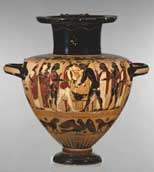
Peleus and Atalanta Wrestling Match
Antike Vasen – Keine alten Blumentopf: – Ringkampf um das Fell des Kalydonischen Ebers,
housed in State Museum, Munich, Germany

Thoughts of the Greek myth of the famed huntress Atalanta, victorious hunter of the feared Calydonian boar with her bow,  wrestling Peleus, hero king of Phthia, father of Achilles,  pique our curiosity.[1] The circumstances of the match and its outcome swirled around in my mind all night. The myth is curious because a water vessel painting of a woman wrestling––much less against a powerful man––is counter to the reality Greek women experienced. It is known that Spartan women publicly exercised, even wrestled, in the nude. Their husbands, off to war or living in the barracks with other soldiers-in-training, women wrestled, raced, and competed athletically against other women outdoors in the fresh air. They enthusiastically exercised, priding themselves on bearing and rearing strong,  healthy, Spartan sons.

Unlike Athenian women who toiled under “womanly tasks” privately at home––inside the house––Spartan women were an anomaly, probably throughout Greece.

Recording the ncient myth, the artist depicted on the black-figure hydria  the unusual contest, between the powerful man and the amazingly strong woman, Atalanta, whose match  competed at the funerary games of King Pelias.

Atalanta wears a loose loincloth––red. Peleus is nude. With her historic, unusual strength, Atalanta won the match. Curious that she won. Curious that she wore only a loincloth. Women always were depicted as wearing demure, floor-length garments. A sort of loincloth shorts, of course, were more practical. Flowing robes defeated the purpose and would be unconvincing. How could she wrestle tangled up in folds of cloth from woman’s traditional tunic-peplos garment? And certainly, she could not wrestle the king in the nude.

With inordinate strength and strategy, with expectation and determination to win,  Atalanta, known never to back down from a challenge, outwrestled a mighty man––a king.

Most curious. What was the message of the myth? That given freedom to move unencumbered by demure and proper long garments was an equalizer? What other encumbrances inhibited Greek women from competing and winning? Permission? Confidence? Courage? We have written that other women in ancient Greece did not seek permission to break tradition and  succeed.

What difference does skill and a winning attitude make in the success of your life?

[1] https://www.antike-am-koenigsplatz.mwn.de/index.php/de/staatliche-antikensammlungen/43-sammlung-und-rundgang


Dear Fellow History Lover,

I appreciate your response to this blog. Please leave an opinion, input, or question by clicking on the Leave a Comment button, or communicate directly with me at [email protected] .

Grātiās tibi !
Dr. P. D. Sargent,

Ancient Scribe sharing new ideas twice a month 

Filed Under: Blog

Bounty to Fill the Belly

March 1, 2023 by Patricia Sargent Leave a Comment

Have you ever been so hungry that you could eat “nearly anything”?
Well, you are not the first to be that ravenous, for early humans searched for food daily in the air, on the ground, and even under the ground when choice was sparce.

As with all living creatures, hunger was a driving force for early humans. Birds and all wild creatures spent most of their waking hours in search of food. Hunter-gatherers had to locate climes where edibles grew in the sunshine. When seasons changed, they migrated, sometimes from mountainous terrain to the shores of the sea. When a huge climate shift occurred in prehistoric Japan and large animals in the mountains died from the cold, meat eaters became seafood lovers. With a shift in the earth and atmosphere, climate changes periodically­––naturally. Necessity demands adjustment.

When humans perfected rock-slinging skills, they were able to bring down, not just rabbits and prairie hens, which they could not outrun nor snare, but antelope and other small swift mammals. Through honed skill in creating efficient stone weapons, like knives and scythes, killing and butchering prey became easier. With protein added to the diet, surely humans gained more physical strength, endurance, and perhaps a longer life.

Foraging began as primal hunter-gatherers’ main occupation for subsistence, and in wartime, it was often the only survival for bombed out cities with no animals and no farms. In North America, foraging had a resurgence for its health benefits, as well as a survivor skill,  beginning with health food advocate Euell Gibbons in the 1960s. Now many books have been written extolling the benefits of “nature’s bounty” and we humans find ourselves back to where we began, but with choice rather than desperation.

From that early beginning, only imagination limited food choice. In modern France, land snails, escargot, are  favorite fare, and until recently shops sold horse meat. While the lack of refrigeration kept pork off the menu of Hebrews and Arabs, Asian women kept pigs, easy to care for and breed, in the backyard. They still prepare and enjoy various offal, unwanted waste, and organs in their delicious food. Across the seas, Europeans even prepared pickled pigs’ feet and added trotters, pettitoes, pig’s foot, filled with fat and protein, to their menus. With exceptions, the world loves pork. Throughout the world, women tended domestic fowl, chickens and ducks.

Sheep were perhaps the earliest domestic animals to be enjoyed at table. Ancient peoples raised herds of sheep, and goats driven from pasture to pasture, to graze. Sheep not only yielded meat, but also wool for the weaver. As they were for Abraham and Sarah, herds of sheep meant money and other treasure. A gift of herds from a guilt-ridden pharaoh including “sheep, goats, cattle, male and female donkeys, male and female servants, and camels,”1 made Abraham a rich man.

In lands where cattle thrived, beef was enjoyed. In Egypt, where people worshipped animal gods––like the Mnevis, Apis, and Buchis ­­­­­­ bulls, and the cow goddess, Hathor­­––who had more temples than all the other gods––cattle were bred for food. People from across the globe enjoy different cuts of beef. British enjoy a joint of beef, a roast, some relish Rocky Mountain oysters, bull testicles. Still others, in Kazakhstan and Kyrgyzstan, prefer the delicacy of bovine rectum.

In Spanish and Mexican bullfights, the victorious toreador cuts the tail off the tortured and defeated bull as a trophy of his victory over the powerful beast and proudly displays it as he marches heroically around the arena for all to see. The bull’s tough meat is probably ground for chili, stews and street tacos.

From the rivers and the seas were gleaned delicacies: mollusks––snails, clams, mussels,  and sea slugs––lobster, shrimp, turtles, fish of every description, octopus, and other denizens of the deep. The Japanese still enjoy a fine gourmet soup garnished with a floating fish eye. Westerners have enjoyed a bite of rattlesnake.

Hungry humans have adapted their palates to everything from hummingbird tongues on the Roman feast table to breast of partridge. One is reminded that even insects have been a tasty treat as St. John the Baptist ate wild honey and locusts,2 and today Oaxacan chapulines, toasted grasshoppers, are a tasty treat and enjoyed on North American menus. Humans learned to appreciate Earth’s bounty.

1 Old Testament. Genesis 12:16
2New Testament. Mark 2:16

Dear Fellow History Lover,

I appreciate your response to this blog. Please leave an opinion, input, or question by clicking on the Leave a Comment button, or communicate directly with me at [email protected] .

Grātiās tibi !
Dr. P. D. Sargent,

Ancient Scribe sharing new ideas twice a month 

Filed Under: Blog

Ayala In Her Moon

February 15, 2023 by Patricia Sargent Leave a Comment

Human beings live with our biology. We address The Law of Nature and dismiss dismal fears imbued in ancient world Myth.

As we breathe the breath of life, contemplate the myriad thoughts of our minds, and respect the functions of our organs, we celebrate—with understanding—the mysteries of  preparation and conception of new life.

For all time, women’s curse—decreed by a deity—is to desire her husband and to bear his child in grievous pain. Her desire and his pleasure perpetuate the race.

But even without desire, a woman also bore the pain brought on by a rapist’s attack that foisted upon her an unwanted child. Pregnancy was a happy/sad occurrence. Legitimized by marriage, a new child enriched the tribe and the Hebrew nation. The birth was a cause for celebration and gratitude. However, delivering a child with no legitimate father, humiliated her family who demanded infanticide to keep the gene pool pure, and caused the woman’s death by stoning. Like Eve, who was said to have inveigled Adam to disobey, the woman was to blame. Eve epitomized Original Sin and was proclaimed guilty throughout the ages.

Another aspect of the deity’s curse was the monthly preparation for birth, what even into the twentieth century women called menstruation –– “the curse.” The young girl, Ayala is a symbol of “everygirl-everywoman.” Her normal human function came upon her when she was almost twelve. In her, the eternal cycle repeatedly continued monthly. Nothing prepared the innocent girl for that shocking experience. Nobody explained to her what to expect. When the bleeding started, she thought she was dying. Had she injured herself? Where could she turn? Who would save her? Who would she dare to tell?

The subject was extremely private, embarrassing, and confidential. Eventually, as girls do, she had to confide in a girlfriend, a sister, or her mother. Reassured that her experience was normal, Ayala dealt with her new “sickness,” a sickness, she was told, that affected all women. One day soon she would become a mother, have status in the family, and be treated with respect. But Ayala  barely had time to be a child herself. The prospect of responsible adulthood was daunting, and the promise of dignified motherhood was far from joyful. She would soon be married.

The process exacerbated Ayala’s difficult life. Her mother warned her to stay away from men, be cautious when she went to the well for the family’s water, and always go with other girls to the river when she washed clothes. She was, in fact, responsible to keep herself “pure.” Ayala withdrew from the boys and girls she played with. She became shy, reserved, and filled with shame. She learned that women who led a sedentary lifestyle could endure the seven days of incapacitation. Washing and reusing rags from old clothing to keep from ruining her clothing was distasteful and difficult to hide from those around her.

She wondered about the nomadic Bedouin women, those who still trekked the desert tending their goats and dromedaries to hunt for food. How did they keep their condition private? How could they tend to cleanliness while there was no water in the desert? Some people were known to wash their hands in the desert sands, but Ayala didn’t think that would work for women’s needs. At least Ayala learned she could depend on her “free days” according to the moon. No wonder some women worshipped the Moon Goddess, the Shekhinah, the Divine Feminine or Malkah haShamayim, the Queen of Heaven. YHWH, Yahweh of the Israelites, would not understand.

Ancient scribes gave the reason for the deity’s curse. It was because the woman disobeyed His admonition not to eat a certain fruit in the Garden. For her disobedience, she would hereafter suffer painful birth and yield to total subjugation to her man. For eating a pomegranate?

As her people cursed her for the natural process of monthly bleeding, set her aside to remain in what some call “the red tent,” in secluded  company of other cursed females, declared her anathema, and admonished her––for no fault of her own––as “unclean,” she was taboo for a quarter of each month and would continue to be for the duration of her child-bearing years. This denunciation of a menstruating woman or girl was common in many parts of the ancient world. For a quarter of her life, she would live in shame. When she emerged from the company of other cursed girls and women, she had to  purify herself in running water. Only then, Ayala was allowed back in the company of her family and the tribe. She was even permitted to enter the Temple. Of course, the taboo repeated as once again she was “in her moon.” Since ancient times, and in many cultures, woman’s “curse” is measured by the phase of the moon.

Filed Under: Blog

Next Page »

Copyright © 2026 Patricia Sargent
Terms of Service & Privacy Policy | Data Access Request